
Training masons to build seismic-resistant schools
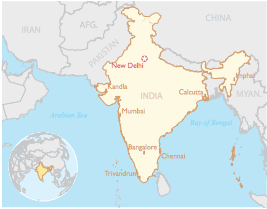
Country: India
Organisations: India’s national and state governments, United Nations Development Programme (UNDP), World Bank
Hazards: Earthquakes
A state-wide school construction program
In response to the widening education gap, in 2004 the Uttar Pradesh State Government planned a massive school construction project.. At this time, the UNDP Disaster Risk Management Program (DRMP) as well as the Education for All (EFA) initiative were both underway at a national level. Some UNDP and Ministry of Education officials saw the school construction project as a chance for disaster risk reduction, and decided to teach the ministry and state government about safer schools.
Influenced in part by devastation caused by the 2001 Gujarat earthquake (in which 15,000 schools collapsed) and two historic earthquakes in Uttar Pradesh, the state government decided to change their existing school design, which lacked earthquake safety measures. Under the DRMP, the Indian Government created the position of National Seismic Adviser, who was responsible for updating the existing design. Uttar Pradesh contained different earthquake zones, but given the large scale of the project the government decided to create a design suitable for the highest earthquake probability in the state.
The National Seismic Adviser changed simple features in the school design to increase its seismic resistance. These included:
- Moving doors 60cm from vertical joints
- Adding rebar to tie foundations and slabs together
- Placing three horizontal ‘earthquake’ ring beams along the walls (at the foundation, below the window, and above the window)
- Increasing the proportion of cement to sand and stone blast in the foundation.
After determining that the changes would add an additional 8 per cent to construction costs, the Ministry of Education entered a year of negotiations with the World Bank. The Ministry wanted to increase their longstanding loan that had supplemented national and state funding for EFA. With funds in hand, the state needed to train masons to build safer schools.
Challenges: training masons and inspectors in safer school construction
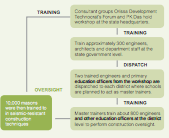 In 2005, the Ministry of Education and Ministry of Public Works organised a massive cascading training program (where newly-trained staff go on to train other staff) to teach hazard-resistant construction techniques to government engineers. These engineers then taught or supervised thousands of contractors and masons at the district level. Amid other DRMP activities, it took a few years to complete the training. In the process, the state government had to deal with a lack of knowledge and the huge extent of construction.
When Uttar Pradesh changed its school design to incorporate seismic-resistant features, the state needed to train masons in the new practices. Five-day training included practice on a mock building could teach one or two masons for each new school site how to construct earthquake ring beams in the walls. These trained masons then spread the knowledge to other masons on the construction site. Photo: Sanjaya Bhatia.
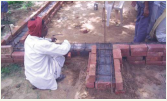
UNDP hired consultants to lead five-day training sessions for masons in communities where new schools were to be constructed. The first part of the training was a lecture to introduce masons to hazard-resistant construction and show them new techniques for earthquake safety. The latter part of the training was applying all-new, hazard-resistant construction techniques on a mock building, giving the masons a chance to translate the theory into practice. The mock building was only constructed to the window level, and was left in the community as a reference for masons to recall what they had learnt. During training, masons were paid their daily wages. Because of the scope of the project, only one or two masons were trained for each school construction site. However, they were able to pass their newly acquired knowledge to other masons working with them.
Tight quality control
Construction was overseen by trained engineers and applied by the trained masons. Masons and a school oversight committee knew the stages that required engineering inspection, the criteria for approval, and the tests conducted to ensure quality. Engineers monitored the masons as they poured the foundation, cast earthquake ring beams, and placed the roof.
With so much training over such a short time, the Uttar Pradesh government knew applying the new techniques would be inconsistent and would need further oversight.
To solve this problem, the team created a wordless manual with very simple pictures to show villagers what should be present at the foundation, and skill levels required. The manuals also showed community members how to determine the quality of cement. The village head was then issued pre-stamped postcards with a checklist of poor construction practices. If there was no problem, the village head would send nothing back. If the government received a postcard, it would immediately send a trained inspector to determine whether a mistake had been made.
Through this method, many errors were caught early, and several buildings were actually demolished after finding irreversible mistakes. If the builder simply made a mistake, it was corrected. However, if the responsible party was corrupt, the builder was banned from future government construction projects.
By 2007, the state government had constructed 6,500 seismically safer schools and 40,000 additional classrooms. Programs of this scale only happen when countries attempt to fill large gaps in access to education. Even though programs on this scale are rare, they can be an opportunity to introduce new knowledge of hazard-resistant construction principles into communities and government agencies.
Key takeaways
- Countries addressing education gaps can embed hazard-resistant school construction into their rollout.
- Cascading training is an effective model for spreading new, hazard-resistant construction techniques to skilled tradespeople.
- During training, new construction techniques need to be tuned to the literacy level of skilled tradespeople
- Training programs should include hands-on practice so skilled tradespeople can apply new concepts.
- Monitoring systems via postcards can enhance traditional construction inspection in rural and remote school communities.
