
Trade-offs in Post-Disaster Response
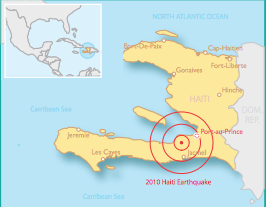
Country: Haiti
Organisation: Save the Children
Hazards: Earthquakes, flash floods, high winds
Country and hazard overview
In 2010, a devastating earthquake struck Haiti and damaged or destroyed 80 per cent of schools in and around the capital city, Port-au-Prince. Nearly 250,000 people were killed, and one-third of the population was displaced. Most documents from the past 204 years of Haitian governance were buried under rubble, and land tenure was almost impossible to determine.
Despite good coordination, the Haitian Ministry of Education was overwhelmed by the crisis. In this extremely difficult situation, Save the Children (who was co-leading the Education Cluster with UNICEF while working alongside other NGOs and the Haitian Ministry of Education) rushed to respond.
From both an educational and child protection perspective, returning children to the classroom was the most pressing goal. The need for immediate relief amid the post-disaster turmoil meant Save the Children had to make difficult trade-offs. Pressures from key stakeholders pushed and pulled the school construction program, sometimes in opposite directions.
A vast coordination effort
The Education Cluster run by Save the Children and UNICEF coordinated the efforts of approximately 100 organisations.
Together, they established more than 1,000 temporary learning spaces, trained more than 10,000 teachers in psycho-social support for children, enabled the return to school of more than 1 million students, and undertook cholera-prevention activities in 20,000 schools.
Save the Children alone constructed at least 100 schools, which helped thousands of children get off the street and into successful education programs. Surveys indicate that community members were extremely grateful for Save the Children’s efforts.
Save the Children had to make some key trade-offs during the decision-making process
- Speed vs quality: Construction speed and cost versus building lifespan: is it best to build semi-permanent or permanent?
- Consistency vs diversity: Consistent design for better compliance to safety standards versus design diversity for increased functionality and tailoring to specific site characteristics.
- Cost vs quantity: Higher costs of site-specific design versus the economy of scale that comes with a consistent design template.
- Quantity vs quality: Building more schools versus creating community ownership.
These conflicting considerations show that prioritising time, cost, quantity or quality can only be achieved at the cost of other factors. Many of the key trade-offs were made at the design stage, which in turn dictated the program decisions that followed.
Save the Children opted for a standardised school design and a semi-permanent structure to meet donor expectations of an immediate, cost-effective response.
A semi-permanent building lifespan was seen as a middle ground. Donors were less inclined to lend money for permanent structures when the country was in the emergency and immediate recovery phase. Save the Children had its own goal to build a certain quota of schools and was contractually obligated by donors to achieve those numbers. The Haitian Ministry of Education also requested temporary, immediate construction. Even as they drafted the design, they recognised that some building elements, in particular the plywood cladding, would require maintenance and replacement.
Initially the short-term strategy made sense, but navigating the Haitian economic and political environment took so much time that the original argument for speed was lost. Through a protracted process the semi-permanent school design was approved by the Haiti government, meaning the first schools were completed in June 2011 and the last schools in early 2013; three years after the earthquake. This left Save the Children with two key lessons about trade-offs in construction lifespan: all staff need a shared definition of ‘semi-permanent’, and that there needs to be a well-communicated plan for upgrading schools to permanent structures when they degrade.
Ensuring technical oversight and partnership
Many school construction projects progressed well with the standardised building footprint, while some required compromise to achieve sufficient classroom numbers. In the latter cases, school administrators made informal changes, some of which compromised safety and classroom function. A five-way Memorandum Of Understanding (MOU) was established in an attempt to alleviate these changes. The MOU provided written agreement of the roles and responsibilities of each group in advance, including school staff, the Ministry of Education, Save the Children, the municipality, and the local parent-teacher association.
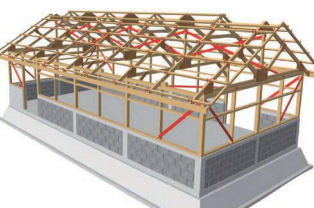
Schools were all single-storey with 190cm-high reinforced concrete skirt walls. The walls were topped with timber framing and clad with plywood. Corrugated metal was used for the roof. Graphic: Save the Children.
