
Influencing Comprehensive School Safety
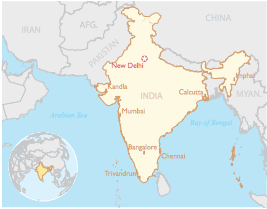
Country: India
Organisations: SEEDS, Nayang Technical University, Ministry of Education, Ministry of Public Works, Temasek Foundation
Hazards: Earthquakes, flash floods, landslides
Creating a culture of safety
In a retrofit pilot project the NGO SEEDS used retrofitted schools as focal points to organise the community around Comprehensive School Safety. They especially focused on Pillar 2: School Disaster Management. This pilot project spanned the three Indian provinces of Himachal, Gujarat and Assam. Each state is in a moderate to high seismic risk zone and has a history of disasters.
To gain the interest of each community, SEEDS held basic orientations at schools to create awareness about Comprehensive School Safety. These orientations were a necessary introduction before building, but were also necessary to explain the school community’s role in school safety, even after the retrofit was complete. The school community would be responsible for operating and maintaining the retrofitted building, improving non-structural elements,, and regularly conducting school disaster management activities. This phase often took six months in conjunction with mason training and other engagement activities. SEEDS anticipated that the school retrofit and disaster management activities would be able to promote a culture of prevention and preparedness in the local community.
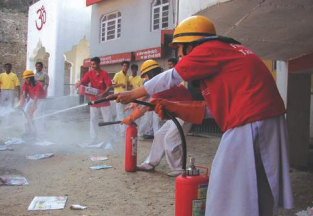
The retrofit of schools in Shimla, India, is part of a broader Comprehensive School Safety approach. After retrofitting is complete, the school and wider community engage in a mock drill to test their readiness. Photo: SEEDS. I
After a school was retrofitted, SEEDS held training in disaster preparedness for community members, school staff and students. The training included search and rescue, fire safety, first-aid, safe evacuation, and creating emergency plans. Students were also trained in ‘duck, cover, and hold’ methods in case of earthquakes and safe evacuation. Special training was also provided to school staff to create a school disaster management plan. Together, the school retrofit and the accompanying ‘soft’ activities with the school community were expected to help promote a culture of prevention and preparedness in the local community.
SEEDS then formed school disaster management taskforces based on the training. There were further divided into functional groups, including search and rescue, first-aid, fire response, and a group to connect with the local government offices. The taskforce members included local leaders and representatives from parent-teacher associations and school clubs.
Establishing a Joint Action Plan
After the school community became aware of disaster risk reduction principles, SEEDS established a Joint Action Plan which connected the school taskforce with the larger community. They performed outreach to ensure the wider community knew the school could be a gathering point in a flood, earthquake, or other sustained hazard. By strengthening this connection, SEEDS wanted to ensure the community benefited from the training and disaster management planning at the school.
Even though the school was likely to operate as a safe haven (and that school taskforces would take leadership roles during a disaster), SEEDS also taught communities emergency preparedness skills and basic hazard knowledge in case the school became seriously damaged.
The Joint Action Plan was designed to help the taskforces react to disasters as well as protect children during their routine interactions with school. One proactive measure included consistent updates for parents on the whereabouts of their children. Disaster or not, if a bus was late, parents were sure to get a call explaining why.
For school communities, the experience culminated with a drill, where the school, fire department, the hospital and local government played the part they would function in a real emergency. SEEDS identified earthquake drills as the most useful exercise to see how prepared students, staff, and communities were. They encouraged the local government to mandate the drill to ensure everyone participated.
After being given a signal, students responded with ‘duck, cover, and hold’ as they had been taught during the disaster preparedness training. They then evacuated the school buildings following the practice of ‘don’t run, don’t push, don’t talk, don’t turn back’. Students left the building by class and organised at a set assembly point.
Realistic scenarios in the drill included some students that were ‘trapped’ in the school or missing. The search-and-rescue taskforce then had to respond by finding the missing people and providing aid. If the missing students were injured, they would be connected with the hospital. It was not just adults that role-played; students also practiced their response skills, and identified damaged buildings, rescued each other, performed first-aid and put out fake fires. The drills were both realistic and exciting.
The biggest challenge for students was to evacuate quickly and establish coordination among the taskforces. However, they became more efficient through multiple practices of the mock drill.
Overall, the process of community engagement, retrofitting buildings, and practicingdrills took a full year. On completion of the project, SEEDS handed the project details (including the disaster management plan, guidelines for retrofit and other project details) to the local education department for implementation in other schools. The governments in several provinces have adopted the initiative for widespread duplication.
Key lessons
- Safer school construction should be integrated into a Comprehensive School Safety program.
- Lessening risk in non-structural building elements is an integral part of Comprehensive School Safety, and a part in which students and staff can actively participate.
- Safer school construction projects provide motivation for engaging communities in school disaster management.
- School drills, especially when coordinated with the wider community, can help encourage a culture of safety and provide good opportunities for practice.
