
School Community-Based Construction
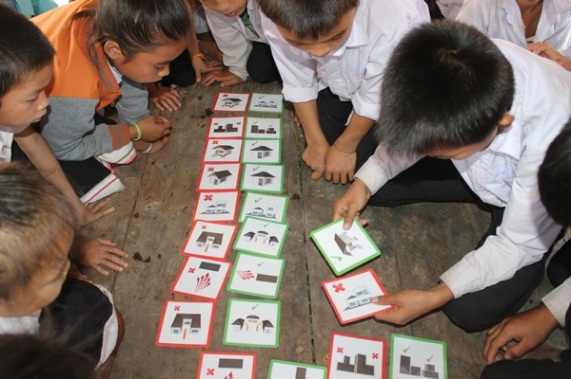
Children play a safe construction card game, Bolikhamxay
Country: Laos
Organisation: Save the Children, Ministry of Education and Sports
Hazards: High winds, wildfires, floods
In Laos, the national Ministry of Education and Sports undertook an education sector analysis, which identified an urgent need to access information about the state and safety of school facilities and improve decision-making processes.
Save the Children supports Hazard Vulnerability and Capacity Assessment (HVCA) in Lao PDR. It supports this both at the community level, where it is led by the Village Disaster Management Committee and includes children, people with a disability, women and ethnic minority groups; and at the school level, led by the Village Education Development Committee and School Disaster Management focal person. Save the Children conducted these HVCAs to allow learning and sharing in the schools and communities and ensure an action plan was developed with locals.
The schools embarked on a series of activities to understand and raise awareness about hazards and vulnerabilities, as well as skills and resources. They also identified their Disaster Risk Reduction Plan (DRR Plan). This was guided by finding key messages for DRR, and activities that taught children and communities about safe construction method. This enabled communities to become familiar with risk in their environment and the structures that surround them, and to find solutions.
Once the School Disaster Management Plan (SDMP) and the community’s DRR Plan were drafted, a district-level technical working group was formed to review both the school and community plans, using quality checklists and markers.
The technical working group consisted of staff from the Ministry of Education and Sports; Ministry of Natural Resources and Environment (including Department of Disaster Management and Climate Change, Department of Hydrology and Meteorology); Ministry of Public Works (including engineers); Ministry of Health; Ministry of Agriculture and Forestry; a representative from the Lao Women’s Union; teachers and education staff; government officials from the provincial, district and community levels (including the village chief); NGO staff; and other relevant key experts.
Once all benchmarks were achieved, local government authorities approved the plans.
To support school safety, the Save the Children project was able to support the following activities in the DRR Plans:
- Buildings designed with hipped roofs for high winds
- Metal and clay roofs in dense foliage/forest area for wildfire resistance
- Retrofitting door hinges for safe evacuation (hinge doors to open outward)
- Ensuring functional access including access to water and sanitation and safe routes to school;
- Non-structural aspects including providing waterproof containers and brackets for shelving in flood-prone schools.
The communities themselves have contributed to completing SDMPs through school site upgrades, including digging drainage canals, planting trees on slopes for stability, regenerating riverbeds, and site clearing for evacuation.
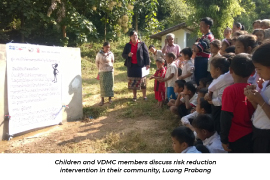
Save the Children used International DRR day to create learning opportunities and promote risk reduction activities. Signposts drew attention to safety features of the construction methods, and members of the Village Disaster Management Committee (VDMC) and student leaders explained these features to the community and answered questions.
