
Rapid visual assessment for retrofitting
Country: El Salvador
Organisations: UNESCO, University of El Salvador, University of Udine, Italy
Hazards: Earthquakes
Country and hazard overview
El Salvador is populous and seismically active. In 2001, two earthquakes caused landslides and damaged 1,700 schools: more than one in three in the country. Ten years later, many school buildings remain in disrepair and on sites that leave them vulnerable to earthquakes and other natural hazards. Many schools do not comply with seismic building codes.
School buildings in El Salvador are mostly one storey of confined or reinforced masonry. Although some buildings were traditionally constructed from adobe (mud brick), it has not been used for schools since 2001, when many children and a teacher died during an earthquake.
Existing school facilities that have not been built to withstand hazards need to be identified and strengthened. In countries like El Salvador, where resources are insufficient for a full detailed assessment of every school, a rapid visual assessment can quickly collect proxy data from a brief site visit. From these assessments, the Ministry of Education can develop school retrofitting programs. These are based on an action plan that prioritises the weakest buildings and those with the most students first. Detailed assessments can then determine whether school facilities should be retrofitted or replaced.
Using rapid visual assessment
Rapid visual assessment approaches have been developed in many countries. These assessments rely on proxy data to determine fragility and the structural integrity of a building
Originally, proxy data was collected by engineers after earthquakes or other hazards. Noting the intensity of the hazard, they recorded the damage to buildings and organised the results by the building type and other defining characteristics. Over time, enough data was collected to predict damage based on a visual assessment of a building’s characteristics and the expected strength of the hazard.
Rapid visual assessment only provides a general prediction of damage. After it is conducted, engineers still need to perform in-depth assessments to develop appropriate retrofit designs, but only for those identified during the rapid assessment. This strategy reduces the cost of doing in-depth assessments for every school.
Planning rapid school retrofits with VISUS
In 2014, faculty and students of a Salvadoran engineering program and researchers from the University of Udine in Italy pilot-tested the VISUS tool as a rapid visual assessment method. VISUS is an expert method that organises and collects information for school facilities using an app on a tablet. It then uses the collected data to judge the overall safety of school facilities. VISUS was designed to quickly gather data with photos and prioritise the right action for achieving school safety based on risk and cost. These actions are: nothing, repair, retrofit or replacement.
While El Salvador has a fairly robust university system, civil engineering students are not required to take courses in seismic safety and evaluating existing buildings. For one month, VISUS developers from the University of Udine in Italy and UNESCO personnel communicated with the Salvadoran professor who spearheaded the pilot project. He provided pictures from previous earthquakes and information detailing the technical aspects of typical school construction in El Salvador. Over time, this partnership became a steering group, which maintained the project throughout its lifespan.
After establishing a base at the University of El Salvador, the VISUS developers trained more than 60 people to perform the assessment on the pilot project, including personnel from the Ministry of Education, engineers associations and a team of 15 students and 8 professors. The first half of the three-day training course was in the classroom, when the trainees learnt the concepts of rapid visual assessment and how to use the VISUS tablet application for collecting data. In the latter half of the training, the trainees got hands-on experience in the field. A day was added for evidence-based photography so experts could verify the team’s assessments.
The VISUS pilot project assessed school buildings in the departments of San Salvador, La Libertad and La Paz. Overall, five groups of three university students and a professor visually assessed 100 buildings in 10 days. VISUS evaluation of each school took as little as a half an hour, and sometimes as long as three hours. When school staff were available to guide the team, the evaluation process was much faster.
The VISUS method can be divided into three broad sections: characterisation, evaluation, and prescription for school safety upgrades. Teams used tablets to photograph structural and non-structural characteristics of schools and then match what they recorded to a set of pre-defined alternatives. The method related each alternative to different damage levels the school would likely experience in an earthquake.
The newly trained surveying team did not always have the expertise to correctly perform the matching. However, the photos were sent to a scientific committee who approved this data and were able to fil in any gaps in experience. This double-checking helped verify the similarity of the collected data, and an algorithm then rated school buildings on a one to five star system ranked by risk and retrofit cost.
Due to its rigorous review protocol, VISUS was able to effectively train and immediately rely on local students and professors for site visits. By producing detailed and functional pictorial evidence, the oversight could be exported off-site, increasing speed and reducing costs.
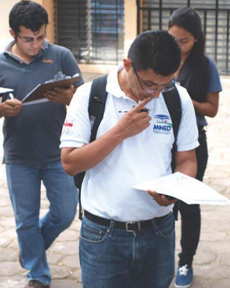 People from the Ministry of Education, engineering associations, students, and professors of civil engineering practice rapid visual assessment of school buildings to determine which are most vulnerable to earthquakes. Photo: Jair Torres/UNESCO
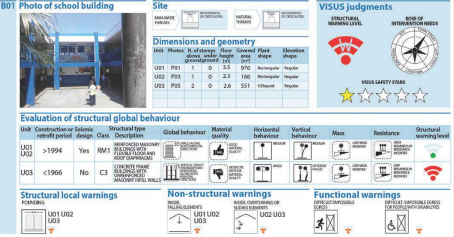
A summary view of the VISUS rapid visual assessment of a school building
Using a series of screens to compare the three units to photos of different building types, and characteristics, the team can categorise each unit and consider global building behaviour, material quality, horizontal and vertical behaviour, building mass, and lateral resistance. The VISUS tool also asks teams to assess non-structural and functional issues. Following a rapid visual assessment, VISUS engineering experts review field assessments and photographs to ensure accuracy.
Challenges to this approach
In the pilot stages, the tablet app did not fully function in the field. Rather than allowing users to assess safety as issues were discovered, the tablet application forced users into a rigid linear progression of the five sections of the VISUS method. Quickly realising this problem, teams recorded information on paper and entered the data once they returned to university. The pictorial comparisons in the app were still essential, but the tablet app needed to be updated to function on the spot.
Rapid visual assessment is only the first step in creating safer schools. The work in El Salvador identified school buildings that were likely to be the weakest, and because the VISUS tool was used, it provided initial estimates for retrofitting or replacing them. While the results of the pilot study are promising, the long-term impacts to Salvadoran schools are still unknown. The Ministry of Education and other organisations still need to fund retrofitting and replacement. Engineers still need to complete detailed assessments, including sampling materials from the schools and testing their strength, before creating retrofit or replacement designs.
Designed in Italy, VISUS focuses on structural types common in southern Europe. Applying this technology in other countries requires modification. The VISUS tool must include traditional building materials like adobe, and also needs to respond to a broader range of hazards in other settings. Currently, the team is conducting other pilot applications in Laos and Indonesia. This requires adapting the tool to entirely new building types and hazards, such as floods, tsunamis, and high winds.
Key lessons:
- Retrofitting programs can improve the hazard resistance of existing unsafe school buildings.
- When resources are limited, rapid visual assessment tools help quickly identify the weakest schools and the schools with the most vulnerable students.
- Local engineers may have little formal training in assessing existing structures for vulnerability to hazards.
- Partnering assessment experts with local universities can build the capacity of engineering students, faculty, and government officials.
