
Fostering Demand for Safer Schools
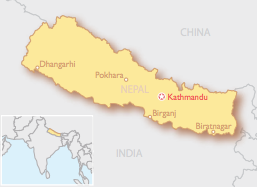
Country: Nepal
Organisation: National Society for Earthquake Technology-Nepal(NSET)
Hazards: Earthquakes
Update: On 25 April 2015, Nepal experienced a magnitude7.8 earthquake, 77 kilometres northwest of Kathmandu. As the earthquake struck at noon on a Saturday, few were inside the thousands of classrooms that collapsed. Tragically, however, some teachers were attending teacher training sessions and were killed.
Country and hazard overview
Nepal is beset with high seismic activity. In the last 100 years, it has weathered four major earthquakes which have claimed more than 11,000 lives. In 1934, the Nepal-Bihar earthquake claimed 8,519 lives and caused massive devastation to Nepali infrastructure and housing. The seismic record suggests earthquakes of that size have occurred, on average, every 75 years since 1250. If historical trends continue, another earthquake is imminent. Smaller and more frequent earthquakes serve as constant reminders of the looming threat.
Organizing communities
In Nepal, the National Society for Earthquake Technology-Nepal (NSET) pioneered community-based safe school construction. Since launching in 1993 with little resources, the organisation has wanted to build awareness about earthquakes and other natural hazards from the children up. At the same time NSET wanted to use a school construction project to bring about earthquake resistant construction practices.
Organising communities to build safer schools requires lengthy engagement and trust-building. A mix of low risk-awareness, limited government capacity, and limited resources drove NSET to focus on finding sites for a few successful projects. Their aim was to ensure the government, as a key participant, saw community-based safe school construction projects as an effective means to protect children, provide education, teach masons new skills and protect Nepali people and vital infrastructure investments.
School selection criteria:
- High community commitment
- Potential for publicity
- Able to be duplicated
- Enrolment
- Viable socio-economic condition
- Availability of construction materials
- Potential for training.
Selecting a school was done with care. In Nawalparasi District, all 239 schools were surveyed to see which needed new classrooms. The number of available local masons was assessed, along with the socio-economic condition of all communities and the available construction materials. Through an analysis of these factors, NSET made a shortlist of around 20 schools.
The most resource and time-consuming part of selecting a site was how to determine which communities would most benefit from a project. The benefit would be higher in communities that did not even know they were particularly vulnerable, or where vulnerabilities were preventable. Benefit would also be high in communities where local contractors or masons failed to follow earthquake provisions mandated by the building codes because they could not read the codes. NSET was more likely to choose these communities, but only if they showed potential for sustained community engagement.
Community engagement began with town hall meetings where community members were invited to learn about hazards and earthquake technology. Initially, attendance was low. As the first few attendees chatted with their families over dinner, tea and at other gatherings, involvement increased. The potential for saving children from harm in the next earthquake proved an effective conversation piece.
Once the initial novelty of the information wore off, sustaining the interest and commitment of the community was a challenge. NSET, along with community members, organised ‘shake table demonstrations’ to continue conversations and demonstrate the effectiveness of hazard-resistant construction.
Shake table demonstration
These demonstrations are now widely used for teaching school communities and local masons about the effectiveness of earthquake-resistant technology. Typically, two one-tenth scale models that look like the local school are placed side-by-side on an apparatus that partially mimics a real earthquake. Although the external design of both models is the same, one of the models has earthquake-resistant features and one is a copy of current building practices. As the table vibrates, the community simultaneously witnesses the potential destruction of their own building, while they are given hope through the model that withstands the earthquake scenario.
Kalika Secondary School was ultimately chosen from all schools surveyed in the Nawalparasi District. Community members were low to middle-income, so there was potential for donations from the wealthier community members and a deep interest in a safer school. The local government was also an eager partner.
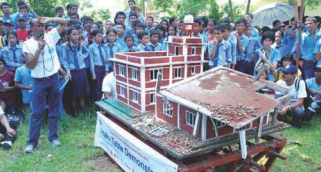
In Nepal’s Nawalparasi District, NSET engineers answer questions at a shake table demonstration. Onlookers learn their traditional building may collapse in earthquakes, but that small changes in their construction practices can save their schools and their lives.
Photo: NSET.
Funding and retrofitting
NSET requires communities to gather almost all the funding required for a school construction project. Their precise method for choosing communities helps make sure that community demand is very high before initiating the project. However, they do not leave schools to operate alone.
At Kalika Secondary School, NSET helped form community-based organisations (CBOs) that would spearhead school retrofit activities. NSET representatives accompanied CBO to request donations from the community and district-level government offices. Again, in the company of an NSET representative, the CBO went to the steel manufacturer asking for a tax-deductible donation, which would be part of the steel company’s corporate social responsibility. As those negotiations began, NSET started to gather in-kind contributions of sand, boulders, and bamboo needed for the construction project. After developing a presence in the area, they were also able to secure some funding from a local NGO to support the project.
NSET was constantly present during construction. NSET engineers remained on the construction site throughout the process to provide on-the-job training for local masons. Training focused on how to construct earthquake-resistant structures, and why the changes produce safer school buildings.
After training masons and demolishing one of the old school buildings, a new three-storey building was completed in 2010. Since then, around 60 per cent of construction completed by the trained masons has included earthquake-resistant technology. NSET has seen masons tear down sections of their work when engineers point out deviations from the safer methods.
Challenges to this approach
Communities resisted new construction practices at first, which made financing especially difficult. Constructing a high-quality building was expensive, and NSET wanted the school to either contribute directly or be involved in gathering funds from other sources. Garnering support and community demand for the project took time before people were willing to plunge into the project and provide time-consuming support. However, after decades of work in the region, Nepal’s Ministry of Education now fully supports the community approach.
Key lessons:
- While enlisting community support can be time-consuming, it can make a big difference to project viability and local procurement.
- Allocating many resources to project selection can be useful when project goals include a focus on scaling-up.
- Raising community awareness through demonstrations and public forums can generate invaluable conversations.
- Shake tables are a particularly powerful tool for creating community interest and demand for safer construction.
- If communities lack the resources to build a school, and they lack the skills to gather the funds from outside sources, involved agencies can help with conversations with public and private groups that may be willing to make donations.
