
A De-centralised Approach to School Construction
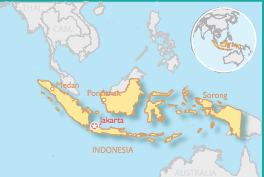
Country: Indonesia
Organisation: Ministry of Education, Ministry of Public Works, Ministry of Finance, World Bank
Hazards: Earthquakes, floods, landslides, high winds, volcanic eruptions, tsunamis
Country and hazard overview
Earthquakes, volcanic eruptions, tsunamis, floods, droughts, and landslides are prevalent in Indonesia. Since 2000, the country has experienced three earthquakes with a magnitude greater than 8.0. Tectonic movements also make 76 of Indonesia’s 150 volcanoes highly active, and the country’s history includes a series of disastrous eruptions that have killed hundreds of thousands of people and affected global weather patterns. Flooding is also a perennial issue. These diverse hazards place about 75 percent of Indonesian schools at risk.
School construction: from a centralised to a community approach
Around 60 per cent of Indonesian schools were constructed in the 1970s and 1980s in a massive Presidential Instruction (Inpres) program, which was fully funded by the government. Understanding of building codes and hazards was low and corruption was rampant, leading to poor site selection and low construction quality. Nevertheless, with Inpres, access to basic education significantly improved and enrolment was boosted.
Recognising the monumental challenge of building, operating, maintaining, repairing and retrofitting schools in various states of disrepair across thousands of islands, in 1999 the government de-centralised education management down to the community level. In 2000, the central government established a block grant called the School Operational Fund with support from the World Bank. This allowed school management committees to directly receive and manage funding provided by the national government.
To actually give power to school management committees, the Ministry of Education and Culture and the Ministry of Finance gave each community responsibility for managing the School Operational Fund. As a block grant, the funding was flexible. It allowed committees to spend money as they saw fit. It was also allocated based on the number of students; if enrolment increased, the funds to that school would also increase.
The school management committees were flexible and consisted of a principal, treasurer, and small group of democratically elected community members. These community members typically came from the immediate area, but could be drawn from surrounding neighbourhoods or elected for special purposes. This system, in conjunction with the block grant, was intended to allow school committees to operate as school implementing units.
Addressing school vulnerability to hazards
After learning that 75 per cent of the 258,000 schools in Indonesia are in disaster risk areas, the government launched programs specifically for disaster risk-reduction education programs. They also adopted regulations to increase the hazard-resistance of school infrastructure.
The Ministry of Education and Culture then contracted a private company to determine the extent of damage of Indonesian school buildings. Considering geographic and logistical challenges, the government allowed school committees to perform basic damage assessments that were then approved at the district level. After years of surveys, the government learned that one-third of all schools (more than 89,000) fell into the heavy or medium category of damage.
In 2011 the Ministry of Finance changed the existing Special Allocation Fund (DAK) (previously used for buying computers or textbooks) to help maintain school buildings. They drastically increased the portion of the budget allotted to physical expenditures and allocated funds according to damage level and student enrolment. School management committees could use these funds to build new schools or repair existing ones as they saw fit.
Challenges to this approach
Construction was a new responsibility for school management committees around Indonesia. They had to hire their own contractors and sub-contractors to help them build new schools or to retrofit existing ones. While committees did receive some assistance from a government engineer, they did not always have the ability to start construction projects or the knowledge to prioritise school safety. As a result, DAK funds have been spent returning buildings to their original condition, rather than improving structural components to make them safer.
According to an Indonesian report prepared for the World Bank, de-centralisation of school construction increased a sense of ownership from the community and reduced costs. Where school communities were already familiar with disaster risk reduction principles and where school principals took the lead in construction, school quality increased.
The Indonesian government is still working through some challenges related to safer school construction:
- Technical oversight: The government has not yet created an appropriate technical advisory system. School communities often lack the funds to rebuild and renew buildings and hire a technical consultant. Even if consultants are hired, they often lack the appropriate information to build hazard-resistant design according to local building code by-laws.
- Public sector coordination: In Indonesia, the Ministry of Public Works is responsible for writing and enforcing building codes, including the design review and construction inspection of schools. Unfortunately, local public works offices are given the same amount of funds regardless of the number of schools in a district. With so many diverse infrastructure tasks to supervise they rarely perform thorough checks – especially if the school is single storey. In addition, public works officials rotate between departments to reduce corruption. This means they rarely develop the experience needed to thoroughly oversee school projects.Under the current DAK fund, local governments have the responsibility of financing the supervision of school projects. Because of this, each unique local political economy can influence the construction costs – potentially compromising quality assurance and safety.Noticing these funding and capacity issues, the Ministry of Education and Culture provided a special portion of money for quality supervision to each school. Currently, this fund is only available for school construction directly financed by the ministry, and not for construction using the DAK fund.
- Construction speed: School management committees must spend DAK funds quickly, which has pressured school communities to implement projects faster than they are capable. Special allocation funds must be used within three months to receive another allocation of money across all sectors. Other departments relying on DAK funds for education materials may pressure schools to finish their work within the three-month funding window so the funds for their sectors will not be delayed.Community-based school construction policy at the national level is possible, but creating incentives that produce safer schools is a complex and lengthy process. In Indonesia, the de-centralised approach may be the only opportunity to reach all communities. At the same time, de-centralised construction and repair may be, in some cases, poor quality. And in Indonesia, where natural hazards are frequent, poor quality work is especially dangerous.
Key lessons:
-
- De-centralised construction methods in regions with diverse circumstances allow locals the freedom to address their unique needs.
- While school management committees can address their own needs well, they may not be immediately capable of managing a construction project.
- Technical oversight must remain a top priority, even if school management committees are given greater autonomy in construction.
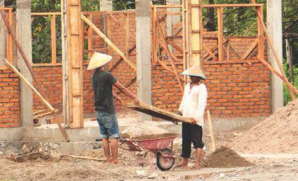
Democratically elected school management committees may use funds to construct new schools or retrofit unsafe ones. Indonesia is working to developing effective systems for providing technical support to local school management committees. Photo: GFDRR.
